Monday, 13 March 2017

Implementing Geography Into Mathematics

Integrated curriculum's are a great way to make classes fun and exciting by combining two different topics from different subjects. This is great for learners who have interests outside of math and allows them to learn about how mathematics applies to the subjects that they be more interested in. In today's blog I will be talking about an activity introduced to our class that integrates geography into the mathematics curriculum and can be used to teach many different topic areas!

For this activity students will need access to a computer or some sort of device that can access the internet. A computer would work the best though as the activity requires precise clicking.

Google maps/Google Earth has an interesting feature built in where you can place markers at various points on a satellite image and measure the distance between these markers. This is great for the measurements unit in the grade 9 locally developed, applied and academic classes and allows students to explore shapes found all around the world!

It can be used as a great way to teach perimeter to students as the measurement tool on Google Earth/Maps allows students to measure the distances from different markers. You can give students the coordinates of various famous places that replicate the shapes that need to be covered in the curriculum such as rectangles, squares and pyramids and ask students to determine various things such as perimeter and even ratios! For example, students can be asked to determine the perimeter of BMO field which is a rectangle. Once they find the perimeter of the field they can find the perimeter of any other rectangular shaped object they want. Once they have both perimeters you can ask them to use a ratio to find out how much bigger/smaller BMO field is compared to their object, which covers two topics at once.

Image result for pyramid of giza
Image retrieved from: http://travelingcanucks.com/wp-content/uploads/2011/10/Pyramids-of-Giza-Egypt-20.jpg

This activity is excellent too because it provides important geography and technology skills such as how to use coordinates to locate an object and how to use google maps to locate objects which is a very useful skill in today's technological world.

Strategies for Teaching Trigonometry

Various topics in trigonometry are covered in the mathematics curriculum throughout high school. In grade 10 students are introduced to similar triangles, right angle trigonometry and the sine and cosine law to calculate missing angles or side lengths. In grade 11 and 12 trig concepts become even more prevalent and abstract involving topics such as the ambiguous case, trigonometric identifies and the graphing and transformations of trigonometric functions.

In an earlier blog post I discussed the use of spaghetti to produce a graph of the sine function, which was one activity to make trigonometry more hands on. In this post I will discuss a few more options that can make trig a little more hands on within the classroom.

One of the ways trig can be used within the classroom is to look at Pythagorean's theorem and ride angle trigonometry. All you need is some tape, protractors, measuring sticks and square floor tiles. Students can use the tape to cover the gaps between multiple floor tiles, if the tape goes over 4 tiles then the length of that side will be 4. The tap can be used to create a right angle triangle where the length of each side is visually determined by how many squares the tape crosses. The math involved here will be with the angle and the hypotenuse side length as it goes diagonally through multiple squares, making an exact length calculation difficult. Students can measure the lengths of each side with a meter stick or calculate the length of the missing side using Pythagorean's  Theorem. The angle can also be determined using a protractor. Various groups within the classroom can create triangles of different size and record their results to share with other groups. After each group has created a triangle and calculated their missing variables a class discussion can be had about the results discussing how different size triangles effects the angles.
 Image result for trigonometry in classroom tape triangles
Image retrieved from: https://www.teachengineering.org/activities/view/nyu_triangles_activity1

Trigonometric identities, another trig topic seen in the senior level classes, are often infamous among students for being one of the more challenging topics. My goal within my classroom would be to eliminate that stigma against trig identities by creating a classroom culture where student's know its okay to be wrong sometimes, what's important is that you learn from your mistakes and move on! Which is why its important to tell students with trig identities that they require lots of trial and error sometimes, they don't always work out perfectly the first time which is perfectly okay. Another good way to introduce identities is by using non-trig examples first such as:

3x + 4 = 7

Hopefully these strategies can help eliminate the stigma in our classrooms surrounding trigonometry and make the topics fun and intriguing for all the different types of learners in our classrooms!


Tuesday, 7 March 2017

Grade 12 Mathematics

The content in grade 12 mathematics classes are often difficult to make hands-on and interactive due to the abstract nature of the topics. In class we presented a few activities that can be done in grade 12 data management, advanced functions and calculus and vectors that can be used.

One of the most interesting activities presented was a math escape room. If you are unfamiliar with escape rooms, escape rooms are rooms that are full of puzzles that need to be solved in order to achieve a certain goal (usually escaping the room) but within a classroom the goal can be to open a box. Escape rooms involve a large amount of collaboration and problem solving. They are also an excellent team building activity.


Escape rooms are a great activity to do in mathematics classrooms because they allow all students to collaborate and work together regardless of mathematical ability. This is because the escape room can be designed so that all types of learners can excel at the activity. For advanced functions the clues can be designed to reflect many different topics covered in the course such as trigonometry, transformations of functions or exponential growth.

Escape rooms are an excellent activity to do at the end of a unit as a review class, but could also be supplemented with a formal review session as well. The escape room is not only limited to grade 12 classes either. It can be used in any math class as long as the clues are designed accordingly to your classes mathematical ability.
Overall escape rooms are a great review activity for any mathematical topic!

Wednesday, 22 February 2017

Grade 11 Math Lesson Ideas

In class we had two demonstrations for teaching content in the grade 11 math curriculum. One concept was from the grade 11 U/C class and the other from the grade 11 college level. I will first talk about the grade 11 U/C activity.

Spaghetti sine is an activity that can be used in a grade 11 U/C or grade 11 university level math course to help students understand the sine function. This activity would be used during the trigonometric functions unit.

Image result for spaghetti sine math
Image retrieved from: http://www.cwu.edu/math/sites/cts.cwu.edu.math/files/images/Spaghetti_Sine_lg.jpg

This activity requires students to cut pieces of raw spaghetti based on a radians/degree wheel. As students start cutting the spaghetti they should start to notice a trend once they make it all the way around the circle for cutting spaghetti pieces. This provides students with a visual representation of where the sine function originates from and can be used to explore other topics such as periods, amplitude and transformations of trigonometric functions.

The next activity was for grade 11 college mathematics and was very practically suited towards choosing an appropriate car insurance company to save you money. The goal of the activity was to figure out how much car insurance would cost with driving school, and whether or not participating in driving school will save you money on your car insurance in the long run. I found this activity very interesting because I love to save money (don't we all?!) so I thought this would be an excellent lesson during the financial unit that will grab the attention of students easily.

Wednesday, 15 February 2017

Streaming in High School

In class we discussed the idea of streaming in high school. Streaming is placing a student in either academic, applied or locally developed based classes. The stream chosen is often based on the students "best" learning style. Academic classes tend to be more abstract whereas applied classes tend to be more "hands-on." Locally developed classes provided the necessary skills students need to be literate in the subject area but often omit abstract concepts.

The issue I have with streaming is that it limits the students options for their future. If a student is great at mathematics they will likely be in academic math classes but if they have a learning disability for reading and writing they may struggle in English classes which would put them in applied English classes. The issue with this is that you need a grade 12 University English credit to apply to Universities and if the student is a great mathematician but not an amazing writer they unfortunately cannot attend university for anything math related due to the stream they were placed in.

Another issue with streaming is that it happens even before the students enter high school. The students grade 8 teacher will often suggest which stream certain students should be placed in when entering high school. This means the students have to decide their academic future when in just grade 8! I find that unacceptable. We should give the students the opportunity to show their potential in grade 9 and 10 and destream the courses so there isn't so much pressure on students and their parents deciding their academic future at such a young age.

For mathematics in grade 9 the two streams can be broken down as follows:


The applied stream is actually very similar to the academic stream in grade 9 with the only big difference being the omission of the analytic geometry unit. The purpose of these streams is to cater to the different learners present in the school. If we create an environment that positively fosters the learning of every student though, whether math is their strength or weakness, I believe that the streaming would not be necessary.

Tuesday, 7 February 2017

Strategies and Activities for Grade 9 and 10 Academic Math Classes

This week in class we looked at strategies and activities for grade 9 and 10 academic math classes. Daria started the class with a great activity called Battle Slopes which was an interesting way to reinforce the idea of slope in a grade 9 math class.

Battle Slopes had the same goal as the game Battleship, you had to find the location of the other persons markers to win the game. The twist with battle slopes though was that you could only find the other persons markers using equations such as x+1 and graphing said equation on the grid. If the graph of your equation goes through one of your opponents markers you can deduce the location of their "ship."

This game was very fun and had a good combination of strategy and fairness involved. Some strategies would involve doing things such as starting off with a small slope ie. y=x then translating that line either up or down ie. y=x+1 or y = x - 1. The fairness is a result of the randomness with the markers placed by your opponent as both students playing the game will have an equal opportunity to find the location of the markers based solely on the luck of your equation line hitting one of the markers. 
  
Image retrieved from: https://blogger.googleusercontent.com/img/b/R29vZ2xl/AVvXsEgbm3uzi3RoJ9EVo9b4W_RWbmoYykoVyshOjxcCoQt64iMvljmsPn2dqHOhtck4Cg9GWb9ZITsV5qU1ASEGYV9DX5edKGVKBolXI_ikopcznVknY-Y1EuTOJ-qd8vnIIXMggUP-xp6xil2v/s1600/DSCN0747.JPG

Overall I believe this activity would be a good reinforcing tool for practicing slope. This activity could also be used if a lesson finishes early and students need work to do or if students finish a task early. It could even be used later in a future unit as a way for students to review for the upcoming exam.

There are other resources and technologies that can be used to help reinforce other topics in grade 9 and 10 academic classes such as:

Desmos
Manipulatives
Graphing Calculators

It should be noted though that technology should only be used during a lesson if it helps reinforce the learning of the new material, not just as a gimmick tool. 


Tuesday, 31 January 2017

Expanding Your Curriculum Knowledge Beyond High School

Secondary school teachers are often well versed in understanding the components of the grade 9-12 mathematics curriculum's and how to develop lessons that address each of the curriculum requirements. One component that is often overlooked by high school teachers, especially those teaching grade 9 mathematics classes, is delving into the elementary mathematics curriculum. This gives teachers an understanding of where our students are coming from and an idea of the knowledge that they have likely already obtained.

It is important for teachers to understand the knowledge basis from which our students are coming from. This allows us to develop effective lessons that will scaffold on the previous knowledge that the students have already obtained in elementary level mathematics.

During assessment it could also be noted that students may be struggling with a certain concept. This could be due to the lack of prerequisite knowledge in a certain topic from elementary which is hindering students progress in learning new material. Although not part of the high school curriculum it is your role as a teacher to ensure each student is achieving their individual successes, which may require you giving a brief lesson on elementary level topics to refresh student's minds on certain topics.

In our class this week we were given curriculum expectations for grades 7-9 and tried to develop continuum's that would link concept ideas across each grade. This proved to be a challenging task as not all of the topics made direct correlations, especially when going from grade 8 to 9. This showed how big the gap was between content in grade 9 and and elementary, which is why it is important that teachers teaching that grade should become familiar with the elementary level content.


Continnum chart linking curriculum expectations from grades 7-9.

There is also a variety of resources available on Edugains that link curriculum expectations across the grades.

Tuesday, 17 January 2017

First Teaching Block


For my first teaching block I was teaching the light and geometric optics unit of a grade 10 academic science class. During the practicum I learned many new skills and strategies that could be applied to any type of classroom. In this post I will talk about some of the experiences I had while on my teaching block as well as some of the challenges and difficulties that I had to overcome.

This practicum was the first time I had taught in a classroom setting. I had some tutoring and coaching experience but had never run a classroom before. One of the first challenges I encountered while teaching was pacing. Due to being in a university style setting for the past 4 years, my pacing was a little bit too fast at the beginning of block but as I gained more experience the pacing became much better and was definitely one of my biggest improvements.

Being organized was extremely important during the first block. I learned many strategies that I would use in a future classroom to help keep everything organized within the classroom. One of the key organizational strategies that my teacher used was a binder that was always within the classroom that contained extra notes/worksheets. It was the students responsibility if they missed a lesson or multiple lessons to pick-up the notes/worksheets they are missing from the binder which was organized by date of the notes and divided by each class as well. This made it much easier for putting student's who had missed days back on track.

Having an academic class, classroom management and behaviour was not a huge issue for me. Some students would be a little rowdy at times but I found that proximity during lessons and changing pace often would quiet them down.

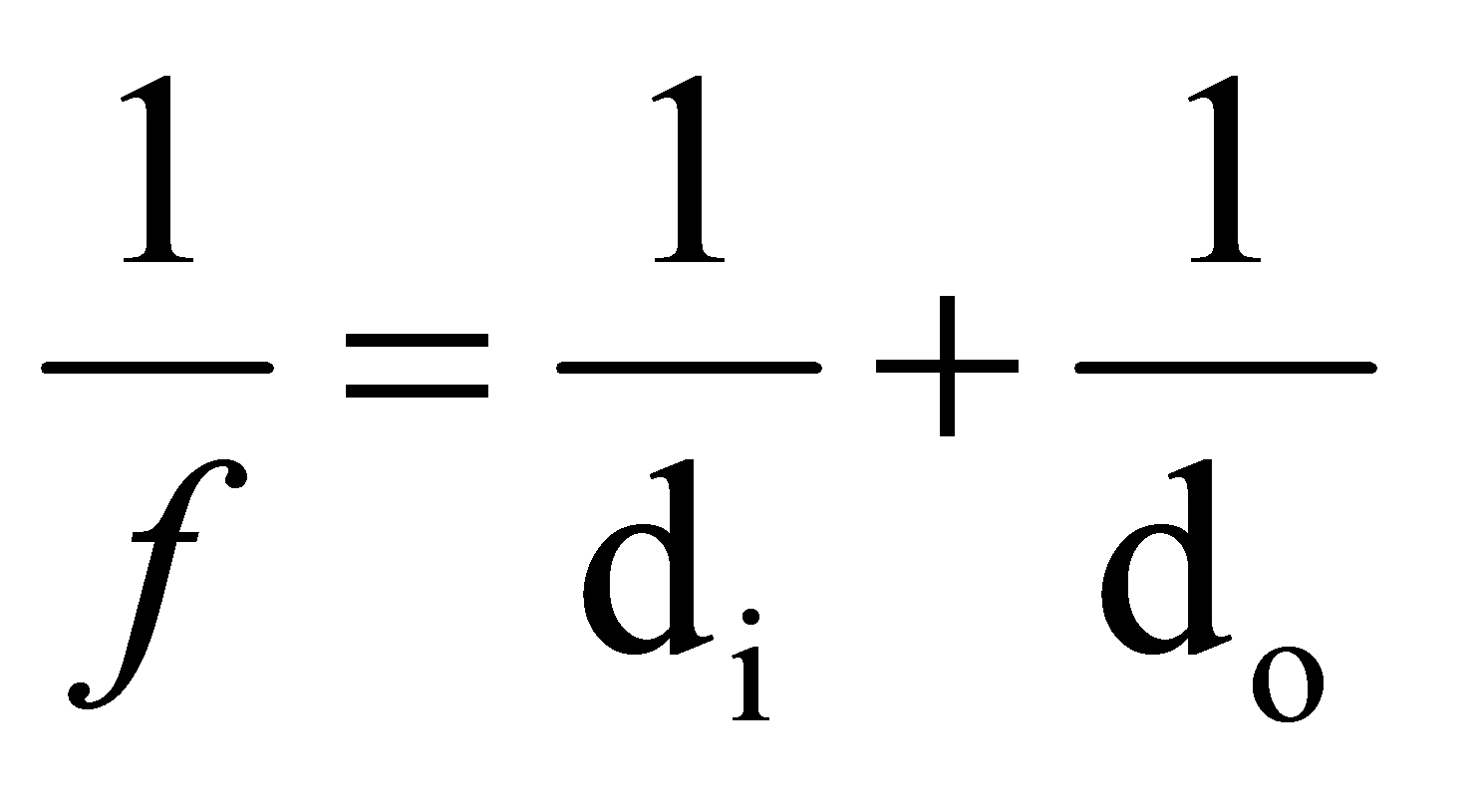
Image result for mirror equation math

Although I wasn't teaching a mathematics course there was still some math involved in the optics unit. The mirror equation shown above was one of the equations we would use in the class to find the distance of an image produced in a mirror. It was interesting to see how all of the students had different math capabilities within the class. I broke down each question step by step and included the class when solving problems to help cater to all of the different leveled math learners within the class. We also did a lab which had a component that applied the equation which the students found useful!
Image retrieved from: http://previews.123rf.com/images/alexraths/alexraths1209/alexraths120900001/15134543-Teacher-with-a-group-of-high-school-students-in-classroom-Stock-Photo.jpg

Overall I found my first block to be very successful. I learned many useful skills that I could use in any future classroom and gained the valuable experience of teaching in a real classroom. Can't wait until my next practicum!


Wednesday, 11 January 2017

Online Session Reflections

Online Session 1

In the first part of the online session we looked at Five Practices for facilitating mathematical discussions around cognitively demanding tasks within the classroom. As a beginning teacher I found that some of these tasks may be a bit challenging for me such as anticipating likely student responses. Because we are all different learners there are students in my class that will likely think of different ways to solve mathematical problems I present that I did not think about. This is perfectly acceptable but as a beginning teacher I may find it more difficult to anticipate all of the student responses to questions due to my lack of experience as a teacher. With more experience though and getting to know my students better it will make it easier to anticipate individual student's responses to questions.


I find the Five Practices beneficial for the classroom because they provide a student-centered approach to learning that creates a more dynamic and engaging classroom. For example, one of the practices is selecting students to present their mathematical responses. This can be beneficial because it shows student's how their peers solve mathematical problems and in an ideal classroom where there is no judging other students you can also occasionally select students with a common error in their formulation of their solution to the problem which can generate discussion as well as enlighten other students who had made the same mistake.

The second part of the first online module challenged us to think outside the box by solving problems using different approaches that students may use. This exercise was useful because it challenged me to use different approaches to solving a problem then what I would normally be used to which is good preparation for when I will have to anticipate student's responses to math problems while teaching.

Online Session 2

Formative assessment is important tool used to determine the level of understanding students have on certain topics/concepts/ideas. There are different ways that you can approach using formative assessment but there are five key universal steps that can be used to help achieve effective formative assessment. One of these steps is sharing learning goals with the students. This allows the students to have an idea of what they should learn at the end of a lesson so that they can asked themselves "did I achieve the learning goal today?" Another very important step is providing feedback that moves learning forward. Feedback can be provided in written, oral or through a demonstration and should force students to engage cognitively about their own work.

Written feedback to a student should provide a question to the student rather than just a "correct" or "incorrect." You should provide the student with a reasoning for why their answer was good or incorrect that allows them to think about other options or methods. For example in a substitution/elimination problem that a student solves using substitution only you may write down as feedback "great answer! can you think of another method that you can use to solve the problem?"

Related image
The teacher should also guide student's using feedback rather than providing them with the correct answer right away. This allows students to think back to the problem rather than just seeing the correct answer and moving on.


Another important thing with feedback that I believe is very important is providing enough time for students to read and think about their feedback. You can provide students with feedback on an assignment or test and tell them to read the feedback and they may or may not do so. Providing time in class to look at the feedback makes it more likely that student's will look at their feedback and cognitively engage in it.

Overall I believe feedback is important tool for all students whether they are struggling or excelling at a topic it can be beneficial for both those types of students if used effectively and this module was a great way of thinking about feedback and how it can be used in a math classroom effectively.

Sunday, 6 November 2016

Using Appropriate Contexts to Teach Mathematics

Have you ever been in a math classroom where a student asks the teacher, "why do we need to learn this?" or "How is this going to help us in real life?" Often times these questions is asked by students when an abstract topic is being taught. Crafting questions and presenting difficult/abstract topics with contexts that connect the material to real life events could help engage students who are questioning why they should learn certain topics.

A great example was done in our class this week where we had to figure out how many classrooms a billion empty shopping bags would fit into. To help solve the problem we were given measuring tape, about 20 shopping bags and a container. Our group decided that we would fill the container given with as many shopping bags possible, then measure the dimensions (length, width and height) of both the container and the classroom. Once we found how many bags could fit within the small container we compared the volume of the container containing the bags to the volume of the classroom. A ratio was then done to show how many bags would fit in 1 classroom. Since 1 billion bags would not fit into just one classroom we found how many more classrooms would be required. It was found that about 225 classrooms would be required to fit 1 billion shopping bags. 
This question was interesting because it addressed a variety of topics such as:
  • Measurement
  • Calculation of Volume
  • Environmental implications
  • Ratios
Figure retrieved from: http://images.teamsugar.com/files/users/6/61259/33_2007/Carrier_bags.jpg

Students are able to use what they have learned within the classroom to solve problems such as these that provide a real-world context.
With that being said, the development of these types of questions may not always be easy. A question such as the one shown above requires the students within your class to be quite familiar with a variety of topics. Some classrooms may struggle with the complexity of problems such as the one above and need more guidance. Because every classroom is different, it is important to develop questions with context that can be solved by the students within your classroom based on the knowledge of your students assessed by the teacher. If you are looking for more real-world type math problems an excellent website to check out is http://www.realworldmath.org/ which has a variety of lessons for teachers to help teach certain topics with questions that give real-world contexts.

Figure retrieved from: http://www.realworldmath.org

Not all context questions require an activity to be performed though. There are many other ways in which teachers can accommodate context into their classroom. The first way is through a "hook" at the beginning of a lesson, A hook is used to generate student interest on a certain topic and can be done in different ways such as an activity, a video, a discussion, etc. Providing a context within that hook allows students to see why it is important to learn the topic that they are about to cover and also may increase classroom engagement.

Overall, providing a meaningful context to mathematical problems can help improve student engagement within the classroom but the way that context is taught should be based on the needs of your students.

What do you think about the importance of context within our classrooms?


Monday, 24 October 2016

Effective Uses of Technology Within the Classroom

New technologies are always emerging to make our lives easier. Many new technologies and gadgets such as Smartboards and graphing calculators have even entered our classrooms to improve the learning environment and classroom engagement. The use of technology within classrooms is also outlined within the Ontario Mathematics curriculum documents on page 8 it reads that,

"The prevalence in today’s society and classrooms of sophisticated yet easy-to-use calculators and computer software accounts in part for the inclusion of certain concepts and skills in this curriculum. The curriculum has been designed to integrate appropriate technologies into the learning and doing of mathematics, while equipping students with the manipulation skills necessary to understand other aspects of the mathematics that they are learning, to solve meaningful problems, and to continue to learn mathematics with success in the future. Technology is not used to replace skill acquisition; rather, it is treated as a learning tool that helps students explore concepts. Technology is required when its use represents either the only way or the most effective way to achieve an expectation."
 Note the final line highlighted in red font. Technology is actually required to be used when it is the best way to achieve a specific expectation within the classroom. For example, in an academic grade 9 mathematics class, many student's in the class may be struggling at understanding how the slope and y-intercept of a linear line can be used to generate an equation for that line. Platforms such as Desmos, an online tool used for graphing, can be used to engage students in graphing linear lines and also allows them to explore a variety of different linear lines by just simply inputting the equation of the line into the program.
Figure: Using Desmos to graph various linear lines.

The tool is easy and very quick for students to use. It will allow them to easily graph multiple lines and see how manipulating the equation changes the slope and y-intercept of the lines. 

Smartboards are another popular new technology present within many classrooms. Smartboards can be used to create interactive lessons that can help increase classroom engagement. The lessons can be created so that students can come up to the board and interact with various objects to solve problems, much like using manipulatives for factoring. 

Overall, technology should be used to help benefit the learning environment for your students. I believe it shouldn't be used to teach every expectation but should be used when it is the most effective way of teaching a certain topic.

Tuesday, 11 October 2016

Diagnostic Assessment

The Summer has just ended and the student's are coming back to school. Some students are excited and eager to learn while others are wishing the Summer would have never ended. A variety of different mindsets are entering the classroom and as the teacher it is your role to make sure that a positive learning environment is present for every student. One of the difficult tasks at the beginning of the school year for teachers, besides motivating students after a long holiday, is assessing the strengths of each student effectively. One of the ways this can be done is through diagnostic assessment, which is not always an easy task.

According to the document Growing Success, diagnostic assessment occurs before instruction begins so teacher's can determine student's readiness to learn new knowledge and skills, as well as obtain information about their interests and learning preferences. 

I remember back in high school each year when I returned back from Summer in my math class we would write a quiz to give feedback to the teacher about what we remembered from math last year. The issue with this type of diagnostic assessment is that sometimes students will forget certain topics if they haven't taken math in over a year (for example, last math they took was first semester of the previous year and they currently have math second semester of the current year) and they'll only need a reminder to refresh their brain on how to do certain topics. I believe a more effective method for diagnostic assessment would be to break students into random groups to allow them to work on questions together. This will allow the students to meet some new classmates and refresh their learning in a peer friendly environment. The teacher can walk around the classroom and assess the conversations being had about the math questions and assist groups in they are having troubles with certain problems. 
Image result for teacher helping students in high school
Figure retrieved from: http://media.oregonlive.com/portland_impact/photo/roosefreshenglishjpg-e31ff160773d042d.jpg

Diagnostic assessment will help teachers get a better understanding of the strengths and weaknesses of their students so that they can prepare their lessons and assessment tools accordingly as the school year progresses. 


Monday, 3 October 2016

Open Questions and Differentiation

One of the many goals in mathematics is to help students develop their critical thinking and problem solving skills. Open questioning is a method that can be used by teachers to engage a students inquiry. According to the asking effective questions document from the Ontario Ministry of Education, open questions are effective in supporting learning because they encourage a variety of approaches and responses. Open questions also intrinsically allow for differentiation, as the student responses to the questions will reveal their individual understanding and knowledge of the topic the question is based from. What are the differences between an open question and a traditional question though?

To use arithmetic as an example, a traditional question would be something along the lines of:

What does 5 x 6 = ? 

Students can do their procedural multiplication technique or use a calculator to easily find that the answer is 30 and then move on to the same type of questions using the same procedures over and over.

An example of an open question using this same topic would be something along the lines of:

Using multiplication, find two or more numbers that can multiply to 30.

This question has various answers and requires students to think about how multiplication works and could also even challenge their algebra and division skills as well. An example of some solutions to this open question could include:

1) 5 x 6 = 30
2) 2 x 5 x 3 = 30
3) -15 x -2 = 30

Notice the various complexity of the answers shown here. Answer 1) uses very basic multiplication to find the solution but still shows understanding of how to use multiplication. Answer 2) is a little more complex requiring students to think a little bit about their algebra skills. Lastly, answer 3) not only shows correct multiplication but also shows that two negative numbers multiply together to make a positive number, combining two different topics into one to solve the answer showing critical thinking.

Open questions can even be brought to the high school level and used for more complex problems. For example:

Create a linear function that passes through the y-intercept at the point (0,4). 
Students can come up with a variety of answers:
Figure: Different linear function solutions to an open question.


For this type of question students need to understand that the y-intercept component of their equation will not change, but the slope can be any number. This allows students to explore linear functions and see how manipulating the equation effects the graph of each function.

Overall I believe open questions are an excellent tool for testing student inquiry while also providing differentiating learning which provides great feedback for the teacher on how well students are understanding certain topics.

Monday, 26 September 2016

The Use of Manipulatives Within the Classroom

Manipulatives are excellent tools that can be used within the classroom to help students understand abstract mathematical processes such as factoring. What are manipulatives though? Manipulatives are any type of object that a student can touch or move to help them learn a type of mathematical concept.

As mentioned earlier, one of the concepts that manipulatives can be used for is factoring. Factoring is a common mathematical process used to break down polynomials. When I was first introduced to factoring I was taught the many steps at how to factor a polynomial. For example, lets use:

To factor this equation a student would have to:

1) Find two numbers that multiply together to equal 9 but also add together to equal 6.
2) After figuring out that 3 and 3 both add together to 6 and multiply together to 9 the equation would have to be rewritten to:
3) The equation can then be broken apart where the student must know exponent rules and how the exponent rules work with variables as well:
4) Lastly the equation can be rewritten as a binomial:

After all of those steps this is the final outcome. For some students this can be easy if you follow the procedure and get your correct factors for step 1, but this is not simple for all students. As an alternative to the stepwise method of finding common factors, manipulatives can be used to acquire the same answer except visually. 

Some manipulatives that can be used to help with factoring are algebra tiles. In our class this week we used the 3 different sized algebra tiles to represent the variables and the two different coloured tiles to represent positive and negative.
 
Figure: Three different algebra tiles used as manipulatives to help with factoring equations.

Now lets try to factor that same equation using these algebra tiles as manipulatives. In order to do this properly the tiles need to be arranged within the box that they are stored in to help with the organization of terms.
 
Figure: Equation represented using algebra tiles.


The algebra tiles are arranged in a square (or sometimes rectangle) to represent the equation that is being factored. Now finding the factors for this equation is very simple once represented in this fashion! To find the factors you only use the "x" tiles and the "1" tiles along the borders of the box. 
Figure: Equation factored using algebra tiles.

The "x" tiles are placed adjacent to the xsquared tile and the number tiles are placed adjacent to the "x" tiles that are within the box. At the top border you have 1 "x" tile plus 3 "1" tiles representing x+3 and the same on the other border. These two equations are your factors for the overall equation!

A benefit to using manipulatives for topics such as factoring is that it allows students to apply the knowledge they learn in a fun way instead of being lectured by the teacher and just doing homework problems over and over again. I think this would be a much better way to help teach factoring to students!

Sunday, 18 September 2016

"Perspective"


One of my fears as a future mathematics teacher is presenting my knowledge in a student friendly language that will help them best understand the content being taught. The reason why this is challenging is due to what I would call "mathematical perspective."

What is this "mathematical perspective" that I speak of? Well, in class this week we did an exercise that involved three rounds of a Tug of War between various creatures. The goal of the exercise was to figure out who would win the final Tug of War based on the outcome of the first two. 

Image result for tug of war clipart
Figure retrieved from: http://www.fotosearch.com/illustration/tug-war.html

The first Tug of War was a tie between 4 frogs and 5 fairy godmothers. The second Tug of War was also a tie between a 1 dragon on one side and 2 fairy god mothers and 1 frog on the other side. The final round had 1 dragon and 3 fairy godmothers on one side and 4 frogs on the other side, but the outcome was unknown. 
Like many mathematics problems, there is only one solution to this Tug of War but, there are multiple ways one could reach that solution (the dragon and fairy godmothers won). These multiple routes to the solution are based on your "mathematical perspective" or how you personally would solve a mathematical problem. 
, 
When our class of nine students was given this problem there were about three different methods to solve this problem, all giving the correct answer. In a high school classroom, this same outcome will likely occur where many different students will have various perspectives at solving mathematics problems. This activity showed us how many students even with the same academic background can look at mathematical problems from different perspectives.

As a future mathematics teacher, I would like to become more familiar with methods that allow me to cater to the various different mathematical perspectives that will be present within my classroom. One of the most interesting and frightening things to me when becoming a teacher is how every student learns differently, but I would like to do the best I can to help each student achieve their full potential.

Ryan

Introduction

My name is Ryan Alt and I am currently in my fifth year at Brock University in the I/S stream of Concurrent Education. My first teachable is chemistry and my second teachable is mathematics. 

I have always had an interest in mathematics and how mathematics can be used to describe so many different things in the universe. While growing up and going through the school system, mathematics was not always my strongest subject though. Along the way I hit a few road blocks, but those road blocks did not stop me from learning and enjoying mathematics. My goal as a future educator is to use my passion for mathematics to help students avoid the road blocks that I encountered and also help them gain a better understanding of the subject. 

Future posts on this blog will be reflections used to engage my learning and create new ideas with my colleagues at Brock University who are also aiming to become future mathematics teachers. This year I hope to learn how to effectively communicate my passion for mathematics through creative lessons and activities to give my students the best learning experience possible. 

This will be an exciting experience to share with everyone. I hope you enjoyed reading.

Ryan